NHS
“Simulation-based techniques and immersive technologies are core ways for training the health and care workforce, alongside traditional educational methods.”
NHS England
Source →
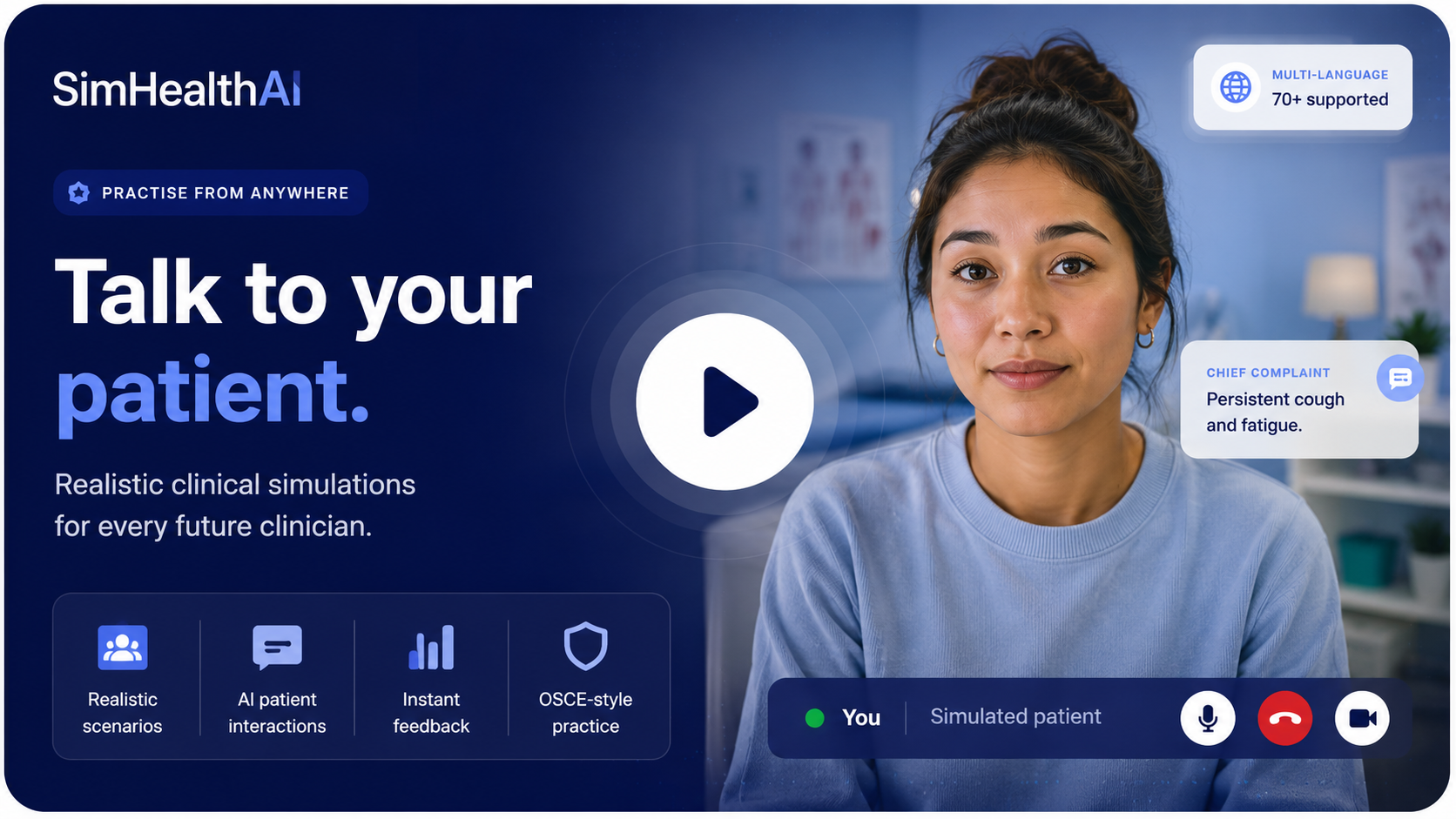
AI-powered patient simulation that gives every healthcare student the hands-on experience they need to thrive in clinical practice.
Free for UK universities through NHS funding






If you run a clinical programme in the UK, this isn't news to you. You're asked to grow intake every year, but the placement hours haven't grown with it.
Clinical placements are the primary constraint on how many students programmes can admit.
Learning opportunities vary depending on case mix, availability and supervision.
Growing numbers put pressure on faculty to assess, supervise and train students.
SimHealth delivers accredited, simulation-based clinical training that counts towards placement hours, so every cohort arrives at placement ready for the cases they'll meet.
For students
Students engage in realistic, virtual patient scenarios.
For educators
Educators retain control over content, assessment, and outcomes.
For programmes
Programmes scale clinical training while maintaining consistent and safe standards across all students.
“The simulated clinics felt realistic and gave me the confidence to practise my clinical reasoning in a safe space.”
“I genuinely found so much benefit from these four weeks. I'll go into my next placement feeling much more prepared.”
“The realistic case studies allowed me to apply dietetic knowledge in a safe, supportive environment, and the structured feedback helped me grow both professionally and personally.”
“Exactly what I needed to bridge the gap between theory and practice before my placement. I went in more confident and prepared for real-world clinical challenges.”
“A great opportunity to adapt to a real-life scenario, gain confidence in assessing patient cases, and give personalised goals.”
“The placement was a great new experience, demanding yet full of opportunities to practise, apply and build confidence in my dietetic skills.”
“The simulated clinics felt realistic and gave me the confidence to practise my clinical reasoning in a safe space.”
“I genuinely found so much benefit from these four weeks. I'll go into my next placement feeling much more prepared.”
“The realistic case studies allowed me to apply dietetic knowledge in a safe, supportive environment, and the structured feedback helped me grow both professionally and personally.”
“Exactly what I needed to bridge the gap between theory and practice before my placement. I went in more confident and prepared for real-world clinical challenges.”
“A great opportunity to adapt to a real-life scenario, gain confidence in assessing patient cases, and give personalised goals.”
“The placement was a great new experience, demanding yet full of opportunities to practise, apply and build confidence in my dietetic skills.”
Delivered through simulation with no additional clinical capacity.
Using structured scenarios and standardised assessment across the programme.
With built-in tracking, feedback, and assessment tools for educators.
Students are assigned cases mapped to programme learning outcomes and placement hour requirements, so every session has a clear clinical purpose before it starts.
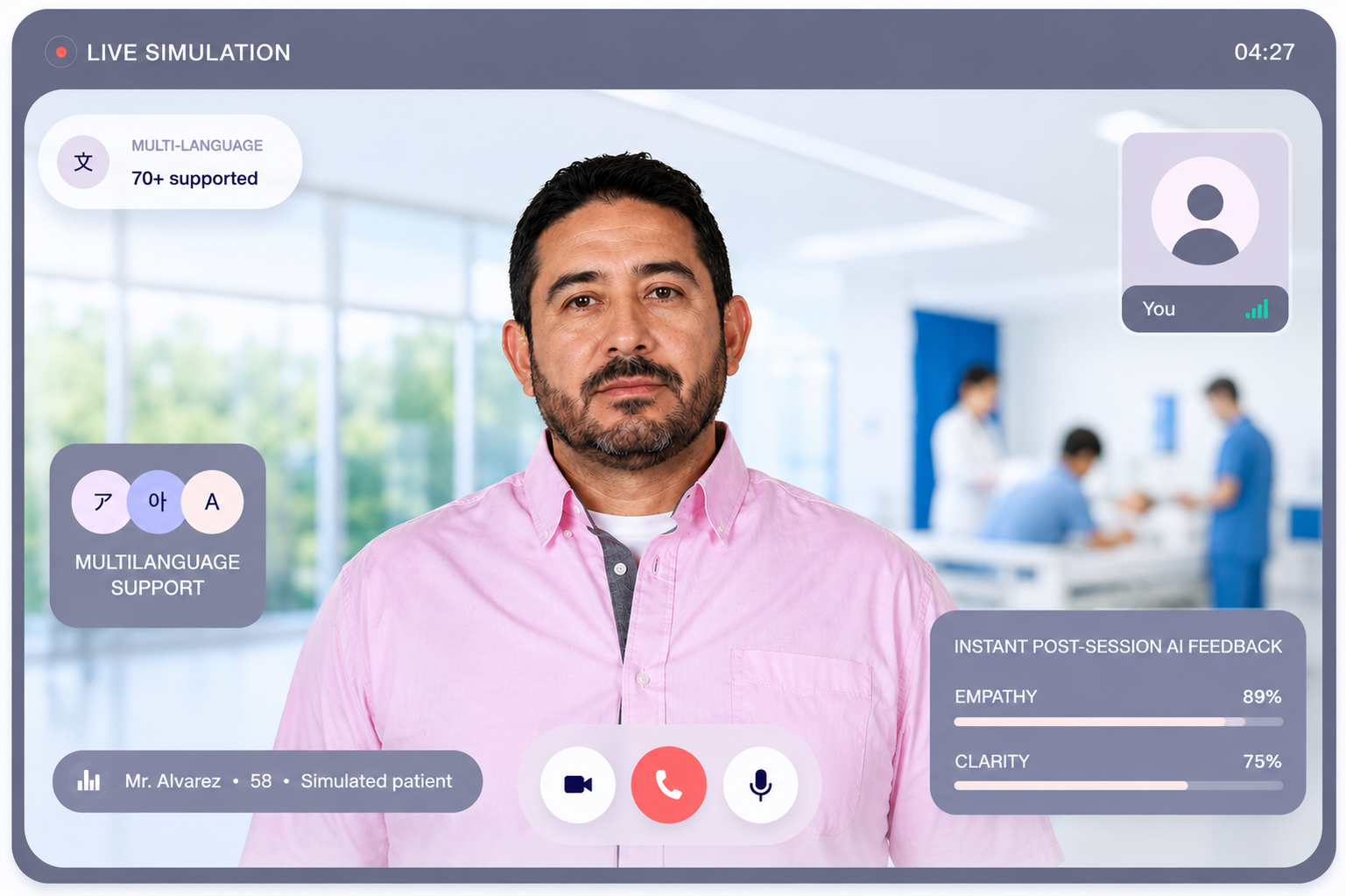
A real conversation with an AI patient who responds naturally, hesitates, and reacts. Students get the communication practice that only comes from a live clinical encounter.
After each consultation, students write clinical notes exactly as they would on placement, building the documentation habit that regulators and supervisors will assess from day one.
Every session is assessed against a 40-point competency rubric covering empathy, clinical reasoning, communication, and triage, mapped to the standards your professional body already expects.
Students complete structured self-reflection, engage in peer feedback, and build an evidence portfolio of their learning. Every session becomes something they can point to.
Every session maps to HCPC, NMC, GMC, and BDA standards — so the evidence you generate is recognised by the bodies that already assess you.
Most universities adopt both: hosted placements to absorb peak demand, plus a curriculum subscription so students arrive prepared and revisit cases between rotations.
“Simulation-based techniques and immersive technologies are core ways for training the health and care workforce, alongside traditional educational methods.”

“Simulation provides standardisation of cases, promotes critical thinking, allows supervision of service-user care, provides immediate feedback, and helps learners assimilate knowledge and experience.”
“Simulated practice learning is an effective pedagogical approach that can enhance the quality of healthcare education and prepare students for the complexities of clinical practice.”
“Medical schools should use simulation training and inter-professional learning to help prepare students for real-life scenarios they’ll encounter in their placement.”

“Recognises simulation-based learning as a legitimate component of practice-based learning, with the proportion permitted varying by professional body (e.g. dietetics 30%, nursing 26%).”
“Deliberate practice with immediate debriefing or feedback from educators, peers and standardised patients allows for reflection, change, and improved performance.”
“Simulated Practice Learning can be structured to meet learning outcomes while alleviating placement bottlenecks, especially when in-person placement slots are saturated.”
“AI-assisted simulated patients are feasible and well-accepted in medical education, supporting repeated, low-stakes practice of clinical communication and improving learner confidence.”
“Simulation-based techniques and immersive technologies are core ways for training the health and care workforce, alongside traditional educational methods.”
“Simulation provides standardisation of cases, promotes critical thinking, allows supervision of service-user care, provides immediate feedback, and helps learners assimilate knowledge and experience.”
“Simulated practice learning is an effective pedagogical approach that can enhance the quality of healthcare education and prepare students for the complexities of clinical practice.”
“Medical schools should use simulation training and inter-professional learning to help prepare students for real-life scenarios they’ll encounter in their placement.”
“Recognises simulation-based learning as a legitimate component of practice-based learning, with the proportion permitted varying by professional body (e.g. dietetics 30%, nursing 26%).”
“Deliberate practice with immediate debriefing or feedback from educators, peers and standardised patients allows for reflection, change, and improved performance.”
“Simulated Practice Learning can be structured to meet learning outcomes while alleviating placement bottlenecks, especially when in-person placement slots are saturated.”
“AI-assisted simulated patients are feasible and well-accepted in medical education, supporting repeated, low-stakes practice of clinical communication and improving learner confidence.”
Join the UK university programmes already using SimHealth to expand placement capacity and lift consistency across every cohort. Free to universities through NHS funding.